
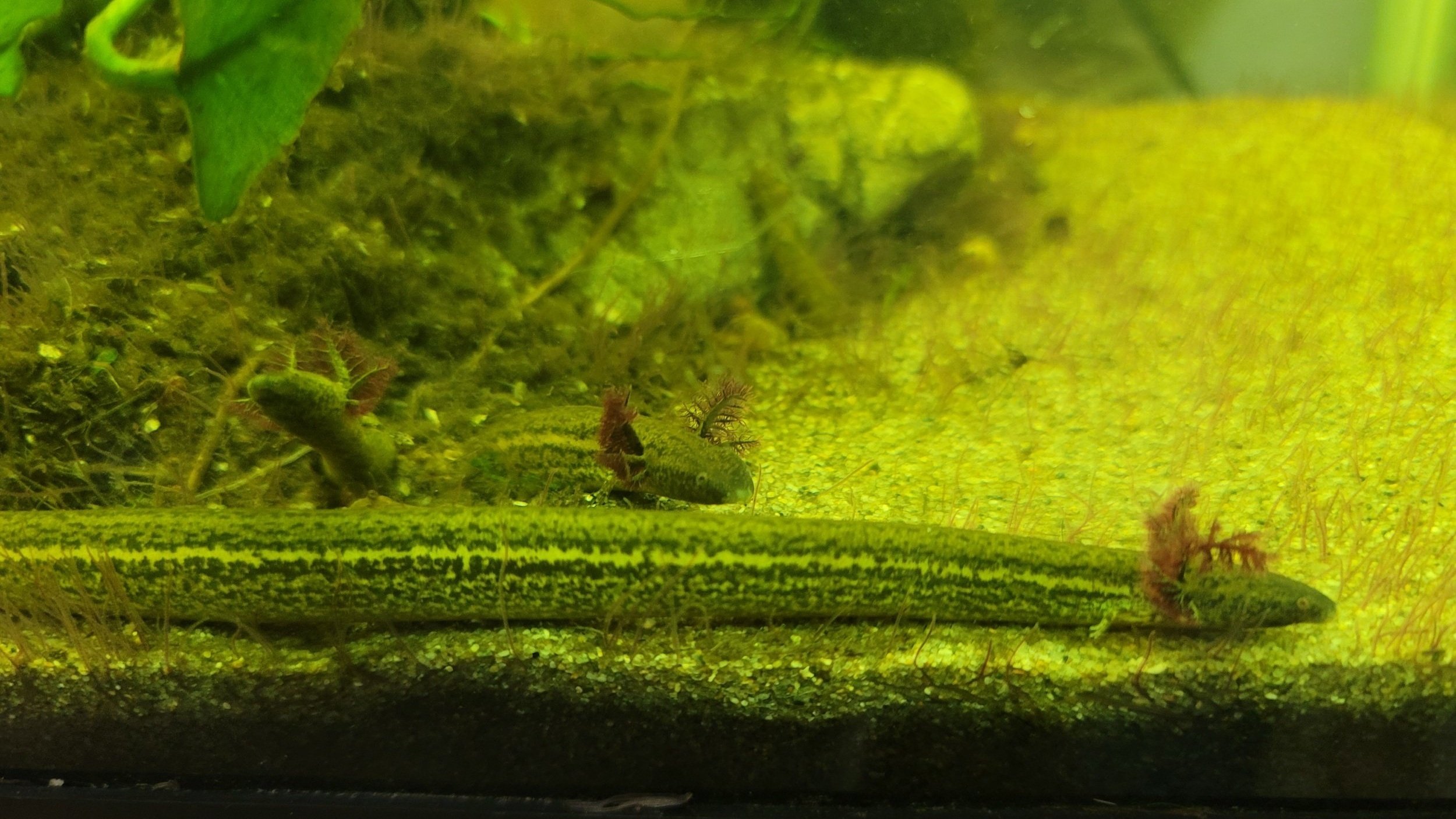
Dwarf Sirens
[Pseudobranchus striatus]
Quick Reference Care Guide
Housing:
20 - 40 gallons depending on number
Water MUST be dechlorinated and should be properly cycled
Water should be kept between 60F and 75F ideally. Room temperature is typically fine as long as your house stays under 80F
Sand substrate necessary. This species spends about 50% of the time with part of its body buried in the sand.
Tankmates should only include other, similarly sized dwarf sirens. DO NOT MIX SPECIES, NOT EVEN OTHER SIREN SPECIES. DO NOT MIX WITH TROPICAL FISH.
Your tank should have a secure lid. Sirens are escape artists, and are surprisingly strong. Escape attempts are especially frequent when they are introduced into a new tank.
Sponge filters are the best option, but mechanical filters are only ok as long as there is 100% absolutely no way for the siren to get into the intake.
Plants such as Anacharis, Vallisneria, Java Moss, and Water Lotus are excellent choices, as sirens really enjoy both hiding and having things to tangle up in.
Hides can be easily made from PVC or ABS pipes from your local hardware store, but sand and some plants are fairly adequate for the most part due to their desire to bury.
normal aquarium lights are fine so long as the sirens have adequate cover.
Food and Diet:
Dwarf Sirens prefer live and frozen food, like blackworms, bloodworms, and brine shrimp.
Lifespan:
There’s not a lot of data on lifespan.
Dwarf Sirens will usually grow to between 10 and 14 inches long, and will be about the thickness of a pencil.
Project Status:
Captive breeding successfully accomplished as of 2021
Animal Availability:
Currently Available
https://www.morphmarket.com/stores/salamantra/
**Note**
-Shipping is possible, but will likely be $50-$75 and is entirely weather dependent. (Overnight shipping only for the animal’s wellbeing)
-Local Pickup available. We are located in Livermore, CA

We should have a steady supply of these coming available regularly now, so long as have the time available to gather and raise the young
Breeding and Reproduction Information
So, compared to Siren lacertina and Siren intermedia, Breeding Dwarf Sirens [Pseudobranchus striatus] has been considerably easier, and virtually effortless once setup properly.
I currently use a 40 gallon breeder tank, but have achieved breeding in a 10 gallon tank as well unintentionally. I keep my 4 original adults together currently (2 male 2 female), and have several generations of adult offspring in the tank as well.
The tank has 4 solid inches of sand throughout the entire bottom, and is packed full of water lettuce that is kept under extremely bright, direct light as its an outdoor, full sun plant normally. For filtration and water movement, I use only 2 large sponge filters, nothing else.
After reaching sexual maturity, the dwarf sirens seem to lay eggs ~ 3 months out of the year. But also sporadically in smaller amounts year round. I dont do anything in particular to make it happen either - they are kept in a light and temperature controlled environment currently that doesn’t give them seasonal cues.They also have a high degree of infertility; around 50% perhaps. The adults wont eat the eggs, and don’t usually go for the larvae intentionally when their are other food sources around. If left in the parents’ tank, the eggs will often dislodge from the plants and drop to the bottom of the tank in the final stages of development. I’m unsure of the significance of this, but it may be to allow the hatchlings to hatch in the safety of the organic muck in the bottom of the tank; this muck harbors tiny microscopic and near-microscopic organisms and detritus that the hatchlings eat.
I originally would remove the eggs as soon as I notice that they are fertile, and place them into a nursery tank to hatch and grow. I have since found that with enough food and cover, a large amount still survive to adulthood when left in the parents’ tank.
Mating Interactions
In the video, you can see the slightly shorter, more slender male, pressing the females body up against the pronounced groove in its head. Sometimes both males will simultaneously do this to the same female.